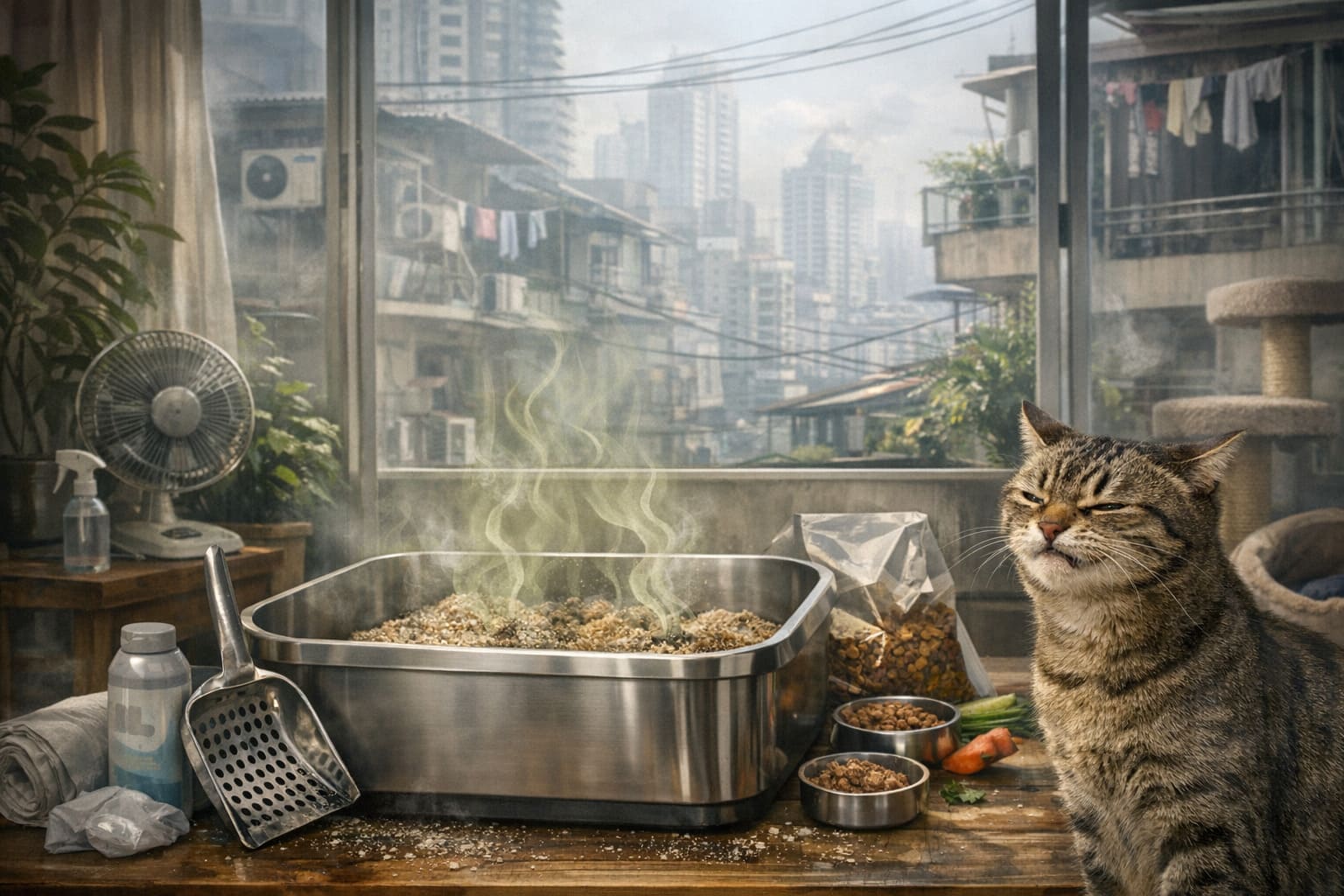
There’s a very specific kind of heartbreak that happens when you open your front door after a long day at the office, ready to embrace the peace of your home, and instead get punched in the face by a wall of fermented ammonia.
It’s that moment where you freeze, key still in the lock, and realize that despite the expensive scented candles and the high-end air purifier, your home has fundamentally become a giant, overpriced bathroom for a four-kilogram predator.
Living in a city like Singapore, Bangkok, or Hong Kong adds a very particular layer of suffering to this. We don’t just deal with “smells.” We deal with humidified smells. The tropical air here doesn’t just carry a scent; it hugs it. It nurtures it. It turns a standard-issue cat poop into a lingering, heavy mist that clings to your curtains and somehow finds its way into your clean laundry.
I’ve been there. I’ve lived through the “is it me or is it the cat?” phase of social anxiety where I’m terrified that I’ve gone nose-blind and I’m walking around smelling like a feral colony. But after years of trial, error, and a lot of frantic Googling at 2 AM, I’ve realized that a stinky litter box isn’t just an inevitable part of cat ownership—it’s usually a cry for help from the environment you’ve built.
It’s the Humidity, Honey (It Always Is)
Let’s talk about the elephant in the room: the 90% humidity outside your window.
In dryer climates, cat pee has a chance to actually dry out if the litter is decent. But here? The air is already saturated. When your cat uses the box, the moisture in the air prevents the litter from doing its one job: desiccating the waste. Instead of a hard, dry clump, you often end up with a gummy, swampy mess that sits at the bottom of the tray like toxic sludge.
This moisture is a playground for bacteria. The longer that “sludge” stays damp, the more the bacteria thrive, and the more ammonia is released into your living room. If you’re tucked away in a high-rise condo with limited cross-ventilation, that smell has nowhere to go. It just circles the dining table, waiting for guests to arrive.
The Fix: You have to fight the air. If you can’t keep the AC on 24/7 (because, hello, electricity bills), you need to position the box in the driest, most ventilated spot possible. Not the bathroom. Please, for the love of all things holy, stop putting litter boxes in the bathroom. I know it’s convenient for us, but the steam from your shower turns the litter box into a literal incense burner of filth.
The Plastic Trap
Most of us start with a basic plastic litter box from the local pet shop. It’s cheap, it’s light, and it comes in cute colors. But here’s the thing: plastic is porous.
Even if you can’t see them, your cat’s claws are creating millions of tiny microscopic scratches every time they dig. Over time, urine seeps into these scratches. You can scrub that box with all the enzymes in the world, but once the smell is inside the plastic, it’s game over. You’re just cleaning the surface of a deeply scented object.
I remember my old plastic hooded box. I’d scrub it until my hands were raw, let it dry in the sun (our classic Asian disinfecting method), and within two hours of putting it back, the ghost of Christmas Past would return.
The Fix: Switch to stainless steel. Honestly, it was the single biggest game-changer for me. Stainless steel doesn’t scratch easily, it doesn’t absorb odors, and it’s incredibly easy to deep-clean. It feels a bit like you’re setting up a commercial kitchen for your cat’s bathroom needs, but the lack of “lingering ghost smell” is worth every cent.
The Tofu Litter Lie
In this part of the world, tofu litter is king. It’s flushable (usually), it’s eco-friendly, and it comes in scents like “green tea,” “honey peach,” or “charcoal.”
But have you ever smelled “Honey Peach” mixed with “Fresh Cat Urine”? It’s not a spa day. It’s a chemical warfare experiment.
Scents in litter are mostly for humans, and they often do a terrible job. They don’t neutralize the smell; they just try to scream louder than the ammonia. Plus, many cats actually hate the strong perfumes, which might lead to them “revenge peeing” just outside the box—making your smell problem ten times worse.
Also, because tofu litter is organic matter (it’s soy!), it can actually start to ferment or grow mold in our humid weather if it’s not changed frequently enough.
The Fix: If you love tofu litter, go for the unflavored, unscented version. Or better yet, look for litters with activated charcoal or those made from crushed volcanic rock (zeolite). These actually adsorb the molecules that cause the smell rather than just masking them with a fake strawberry scent.
The “Input” Problem (The Diet)
I hate to say it, but sometimes the smell is coming from inside the house. Or rather, inside the cat.
We’ve all been tempted by the cheap bags of kibble at the supermarket, the ones with the bright colors and the generic “seafood platter” labels. But a lot of these are packed with fillers—corn, wheat, soy—that cats aren’t really designed to digest.
When a cat eats high-filler food, their body can’t process it all, and the result is… well, volcanic. The more “garbage” goes in, the more “garbage” comes out. I noticed a massive difference when I moved my cat, Mochi, to a high-protein, grain-free diet. The volume of his waste actually went down, and the scent became much less “clear-the-room” offensive.
The Fix: It sounds expensive, but better food equals less waste. It’s a direct correlation. More nutrients absorbed means less rot sitting in the litter box. Think of it as an investment in your own nose’s well-being.
The Ritual of the Scoop
This is where I get a bit vulnerable. There were weeks when I was busy—back-to-back meetings, social commitments—where I’d only scoop once a day. Or, if I was really tired, I’d skip a day.
“It’s just one cat,” I’d tell myself.
I was wrong. In a small apartment, skipping one day of scooping is like leaving a loaded trash can in the middle of your kitchen in the height of summer. The smell doesn’t just sit there; it matures.
But it’s not just about scooping the clumps. It’s about the “dust.” Over time, the constant digging breaks down the litter into fine particles that are too small to scoop but are saturated with waste. This “used” dust settles at the bottom of the box.
The Fix: You need a three-tier cleaning system.
- The Daily Scoop: Twice a day. Minimum. Once in the morning, once before bed. Make it a habit like brushing your teeth.
- The Weekly Top-up: Don’t just let the level get lower and lower. Keep it deep enough (about 3-4 inches) so the pee doesn’t hit the bottom and stick.
- The Monthly Reset: Once a month, dump the whole thing out. Wash the box with hot water and unscented soap (or an enzymatic cleaner). Start fresh. If you’re still using a plastic box, this is when you’ll realize how much smell the plastic is holding onto.
The Layout Mistake
Where is your litter box right now? Is it tucked in a dark corner of the kitchen? Is it behind the sofa?
In Asian homes, we’re obsessed with hiding things. We don’t want people to see the “ugly” parts of life. But by tucking the box into a corner with zero airflow, you’re creating a “stink pocket.” The air stays stagnant, and the smell builds up like a pressurized gas.
The Fix: Pull it out. Give it some breathing room. I know it’s not “aesthetic” to have a litter box in a more open area, but would you rather people see a clean-looking box or smell a hidden one the second they walk in?
I also started using a small charcoal bag—those linen pouches filled with bamboo charcoal—right next to the box. It’s a passive way to soak up some of that lingering ammonia without adding any weird floral scents.
The “Hidden” Culprit: The Mat
If you use a litter mat to catch the tracking, take a good look at it. When was the last time you washed it?
Litter mats are designed to trap things. That includes the tiny, invisible drops of urine that might splash, or the “lingering” bits stuck to your cat’s paws. Over time, the mat itself becomes a source of the smell.
The Fix: If it’s a fabric or “grass” style mat, throw it in the wash or hose it down weekly. If it’s one of those double-layer honeycombed mats, make sure you’re opening it up and vacuuming out the trapped “scented” dust.
A Final Thought from the Trenches
At the end of the day, having a cat is a bit of a sensory compromise. We get the purrs, the head-butts, and the quiet companionship during late-night Netflix marathons. In exchange, we have to deal with the fact that they are essentially tiny tigers living in our living rooms.
But “cat smell” shouldn’t be the defining characteristic of your home. It shouldn’t be the thing you apologize for when someone drops by unannounced.
Fixing the smell isn’t about one magic product. There’s no “miracle spray” that fixes a dirty box or a bad diet. It’s about understanding the environment we live in—the heat, the humidity, the tight spaces—and working with it instead of against it.
Switch the box. Upgrade the food. Open a window. And for heaven’s sake, scoop more often. Your nose (and your cat) will thank you.
After all, your home should be your sanctuary, not a reminder that your cat had fish for dinner.