It’s 3:14 AM. The neighborhood is dead quiet, save for the low hum of the aircon and the occasional, distant roar of a modified exhaust on the PIE. My HDB flat is dark, but I’m wide awake. Why? Because Booboo, my fifteen-year-old ginger tabby, is standing in the middle of the hallway, yowling at the shoe rack like it’s a portal to another dimension.
It’s not a hungry meow. It’s not a “pet me” meow. It’s a hollow, guttural sound that vibrates through the floorboards—a sound of profound, existential confusion.
I used to think he was just getting “grumpy” in his old age. I’d joke with my friends at the kopi-tiam that Booboo was becoming a senile old uncle, forgetting where he put his keys or complaining about the “kids these days” (in this case, the neighbors’ new kitten). But as the months crawled by, the jokes stopped feeling funny. The staring at blank walls for twenty minutes, the sudden accidents right next to the litter box he’s used since he was a kitten, the way he’d get “stuck” behind the sofa and look at me with eyes that didn’t quite see me—it wasn’t just aging.
It was Feline Cognitive Dysfunction Syndrome (CDS). Or, as I’ve come to call it, the long, slow goodbye.
The Fog That Settles In (Unnoticed)
In our part of the world, we have a bit of a “tough it out” culture when it comes to pets. We grew up with “longkang cats” and hardy strays that lived on scraps and street smarts. We’re used to cats being these independent, mysterious creatures that just exist alongside us, surviving on nine lives and pure spite. So, when they start acting weird at fourteen or fifteen, the common refrain from our parents or even some of the older-school vets is, “He’s just old, lah. What do you expect? Just let him sleep.”
But CDS isn’t just “being old.” It’s a literal physical change in the brain. Think of it like Alzheimer’s in humans. Those protein plaques we hear about in medical journals? Cats get them too. Their brain mass actually decreases. The blood flow isn’t what it used to be.
And because cats are the undisputed masters of hiding pain (a survival instinct from their desert ancestors), by the time we notice they’re “senile,” the fog has usually been settling in for a long, long time. It starts small. Maybe they stop grooming that one spot on their back. Maybe they don’t greet you at the door when you come home from a long day at the office anymore. You think they’re just tired. But really, they might have forgotten that the sound of the keys in the lock means “Human is home.”
I remember the first time I realized Booboo was lost. He was in the service yard, standing by the washing machine. He’s lived in this flat for over a decade. He knows every tile. But he was just… standing there, head pressed against the cold metal, looking trapped. I called his name, and he jumped like I’d set off a firecracker. That was the moment my heart broke a little. The map in his head was being erased, line by line.
The Midnight Choir and the “Neighbor Factor”
One of the hallmark signs—and arguably the hardest one to live with in a dense city like Singapore or Hong Kong—is the “Vocalisation.” That’s the fancy clinical word for the 3 AM screaming sessions.
For a senior cat in a high-rise apartment, the night is a terrifying, alien landscape. During the day, there’s the ambient noise of the TV, the neighbors’ kids playing downstairs, the aunties chatting at the lift lobby. There are sensory anchors everywhere. But at night? It’s silent. And for a cat with CDS, that silence is a vacuum where they lose their spatial bearings.
Booboo gets “lost” in a 900-square-foot flat. He’ll walk into the kitchen, forget why he’s there, and the sudden realization that he doesn’t know where he is triggers a panic attack. The yowling is him calling out into the dark, asking, “Is anyone there? Where am I? Who am I?”
Living in an apartment makes this worse. You’re constantly worried about the neighbors. You wonder if the family next door thinks you’re torturing your cat. You end up sleeping with one ear open, ready to bolt out of bed and scoop him up before he wakes the whole floor.
I’ve found that leaving a small nightlight on—just a dim, warm glow near his food and bed—helps immensely. It’s like giving him a lighthouse in the middle of a dark ocean. I also started playing some low-volume white noise or “cat music” (yes, that’s a thing, search it on Spotify). It fills the “scary” silence and gives his brain something to latch onto.
The “Accidents” That Aren’t About Spite
Let’s talk about the litter box. This is usually the point where even the most dedicated “cat parents” start to lose their patience.
I’ve had friends tell me, “My cat is doing it out of spite! He’s angry I stayed out late for dinner or didn’t give him the premium tuna!” Honestly? Cats don’t really do spite. Not like we do. If your fourteen-year-old cat who has been a “Good Boy” for a decade suddenly starts peeing on your expensive teak floor or your favorite rug, he isn’t trying to send a message. He’s confused. Or he’s hurting. Or both.
With CDS, “litter box amnesia” is real. They might remember they need to go, but they can’t remember where the box is. Or, they find the box, but the “entry” seems too complicated. In our cramped urban apartments, we tend to tuck the litter box away in the yard, under a cabinet, or in the “wet” kitchen area to keep the smell away. For a senior cat with stiff joints and a foggy brain, that trek might as well be a hike up Bukit Timah Hill in a thunderstorm.
When Booboo started having accidents, I had to swallow my pride (and my love for a perfectly curated, minimalist home) and put more boxes out. I switched to low-entry trays—the kind designed for kittens. I put one right near his favorite sleeping spot. It felt like my living room was slowly becoming a feline nursing home, but you know what? The “spiteful” peeing stopped. He just needed the solution to be right in front of his nose.
The Social Ghost: When They Forget Your Face
The most painful part for me wasn’t the noise or the mess. It was the shift in our relationship. This is the part people don’t tell you about in the “Senior Cat” brochures.
Cats are subtle, but they are deeply social in their own way. Booboo used to have this ritual where he’d sit on the arm of the sofa while I watched the evening news. He’d head-butt my chin and purr like a rusty engine. It was our “us” time.
Now? Sometimes he looks at me and there’s nothing. No recognition. No spark. He’ll walk past me like I’m a piece of furniture, or worse, he’ll look at me with a flick of fear in his eyes, as if I’m a stranger who just broke into his house. It’s a special kind of loneliness, living with a pet that has forgotten you exist. You’re still providing the food, the meds, the chin scratches, but the “soul” of the cat seems to have retreated into a corner of his mind where you aren’t invited.
I’ve learned to meet him where he is. If he wants to sit in the corner and stare at a shadow, I’ll sit near him on the floor, maybe read a book. I don’t force him to interact. Sometimes, he has a “lucid” moment—a brief window where he remembers he likes his ears rubbed—and I treasure those like gold. It’s like a visit from an old friend who moved away years ago.
The “Sandwich” Struggle: Asian Family Dynamics
There’s a specific layer to this in an Asian household. Many of us are part of the “sandwich generation.” We’re looking after our kids, our aging parents, and our aging pets all at once.
When I told my mother that I was taking Booboo to a specialist vet for his “dementia,” she looked at me like I’d lost my mind. “It’s just a cat,” she said. “In my day, cats lived outside. When they got old, they just… went away.”
There’s often a generational gap in how we view pet care. For many of our elders, spending money on “brain supplements” for a cat seems like the height of modern indulgence. It can be hard to explain that this isn’t just about “pampering” a pet; it’s about fulfilling a responsibility to a creature that has given us fifteen years of unconditional loyalty.
But I’ve also noticed something beautiful. My dad, who was always the most “stern” about pets, is the one who now sits with Booboo in the afternoons. He doesn’t call it CDS. He just says, “The cat is tired.” He’ll put a towel down so Booboo can sleep on the cool tiles without hurting his hips. In our own way, the whole family has adapted to the “old man” in the house.
Adapting the “Kampung” Within: Practical Survival Tips
If you’re reading this and nodding along because your cat is doing the same things, please know you’re not alone. And more importantly, know that there are ways to make their sunset years less scary for them (and less stressful for you).
- Don’t Move the Furniture. Seriously. This is the golden rule. In a senior cat’s mind, the layout of your home is his internal GPS. If you decide to do a big declutter or move the dining table to the other side of the room, you’re essentially deleting his map. Keep it consistent. Let the house be a bit messy if it means he knows where he is.
- Scent is the Secret Language. As their sight and hearing fail, their nose is their last reliable sense. I use Feliway (those pheromone diffusers) to keep the “vibe” calm. I also try not to use heavy, floor-cleaning chemicals with “Lemon Fresh” or “Pine” scents that overpower everything. I want the house to smell like us. Familiarity is safety.
- The “Senior” Diet and Modern Medicine. Go to a vet who takes senior care seriously. There are supplements—DHA, EPA, antioxidants like Vitamin E, and even specific medications like Selegiline—that can actually help clear some of the brain fog. It’s not a cure, but it can buy you more “lucid” days. Think of it as putting the best possible fuel in a vintage car.
- Routine is the Anchor. We feed Booboo at the exact same times every day. We have “play” time (which is mostly just him watching a wand toy move very slowly) at the same time. This predictability is the only thing that keeps his anxiety from spiraling.
- Grooming Help. Senior cats often stop cleaning themselves because it hurts to twist their bodies. Use a damp cloth to wipe them down. It mimics the feeling of being groomed by a mother cat and helps them feel “themselves” again.
The Emotional Toll on the “Hooman”
Caring for a cat with CDS is a marathon of patience. There will be days when you’re frustrated. There will be days when you’re angry because you’ve stepped in something for the third time that week. There will be days when you cry because you miss the cat who used to jump onto the highest shelf and knock over your vases.
In our culture, we don’t always talk about “pet caregiver burnout,” but it’s a real thing. Especially when you’re also juggling work and family. It’s okay to feel overwhelmed. It’s okay to admit that it’s hard.
I remember one particularly rough night, standing in the kitchen at 4 AM, cleaning up a mess and listening to Booboo howl at a cabinet. I thought, Is he even still “in” there? Is this fair to him? Am I being selfish by keeping him going?
But then, he wandered over, leaned his bony, fragile little body against my ankle, and let out a tiny, familiar “mew.” For a split second, the fog cleared. He looked up, and I saw him—the kitten who used to hide in my shoes, the teenager who chased shadows. He was back. And I realized that as long as he’s not in physical pain, as long as he can still enjoy the taste of a Churu treat or the warmth of a sun-patch on the balcony tiles, I’ll be his lighthouse.
The Soft Mic-Drop
We spend so much of our lives training our cats, laughing at their antics, and filling our camera rolls with their “perfect” moments. We love them when they’re sleek and fast and funny.
But the real test of love—the kind of love that actually matters—isn’t when they’re at their best. It’s when they’re at their most confused. It’s when they’ve forgotten how to be a cat.
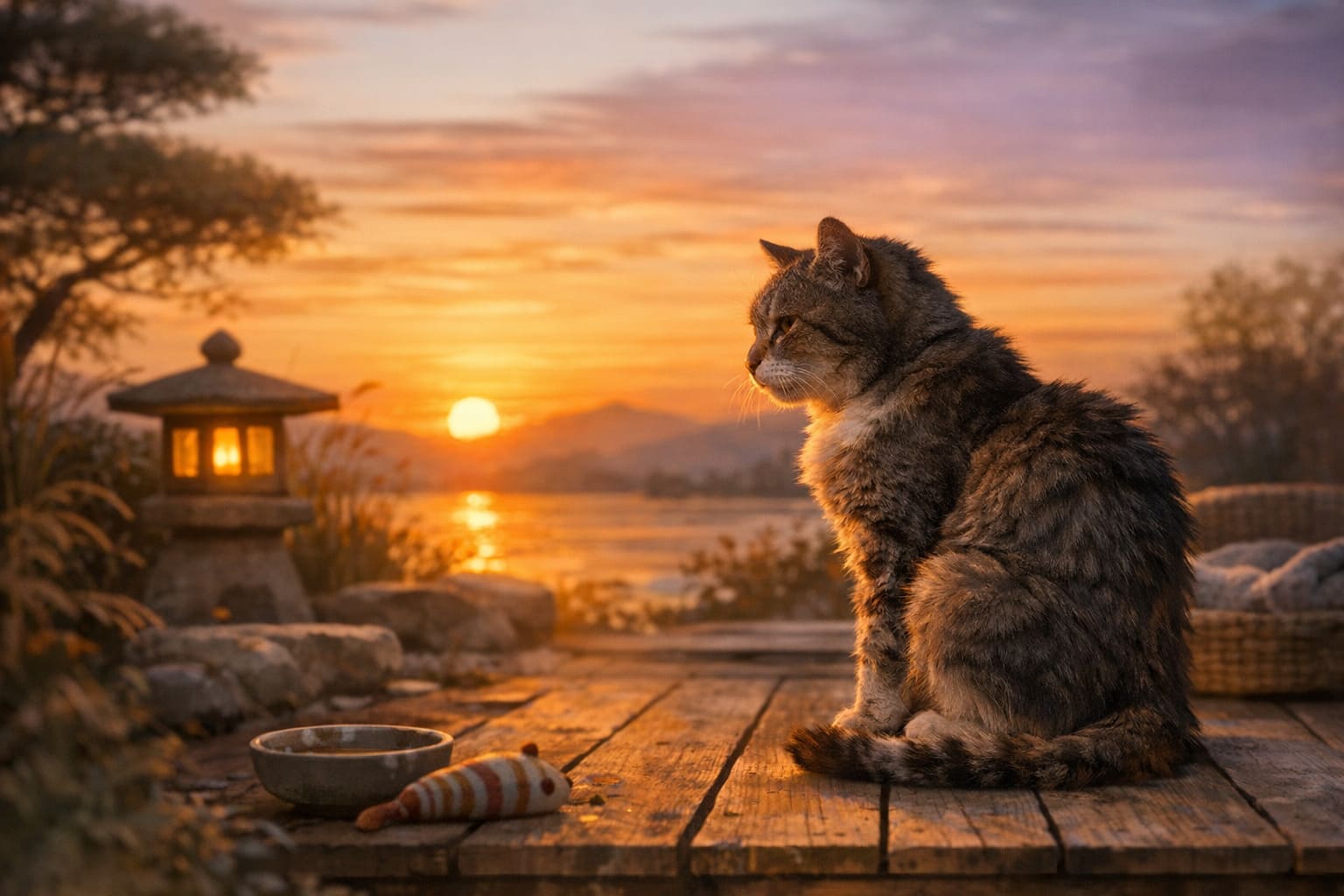
Cognitive Dysfunction isn’t the end of their story; it’s just a very quiet, very strange final chapter. Our job isn’t to “fix” it—because we can’t. Our job is just to hold the door open, keep the lights low, and make sure the room stays warm until they’re ready to go. Because even if they don’t always remember who we are, we remember exactly who they were.
And in the end, maybe that’s the greatest gift we can give them.
One-Line Summary:
A deeply personal and culturally nuanced guide to understanding and caring for senior cats with Cognitive Dysfunction Syndrome, focusing on empathy, environmental adaptations, and the emotional journey of the “long goodbye.”