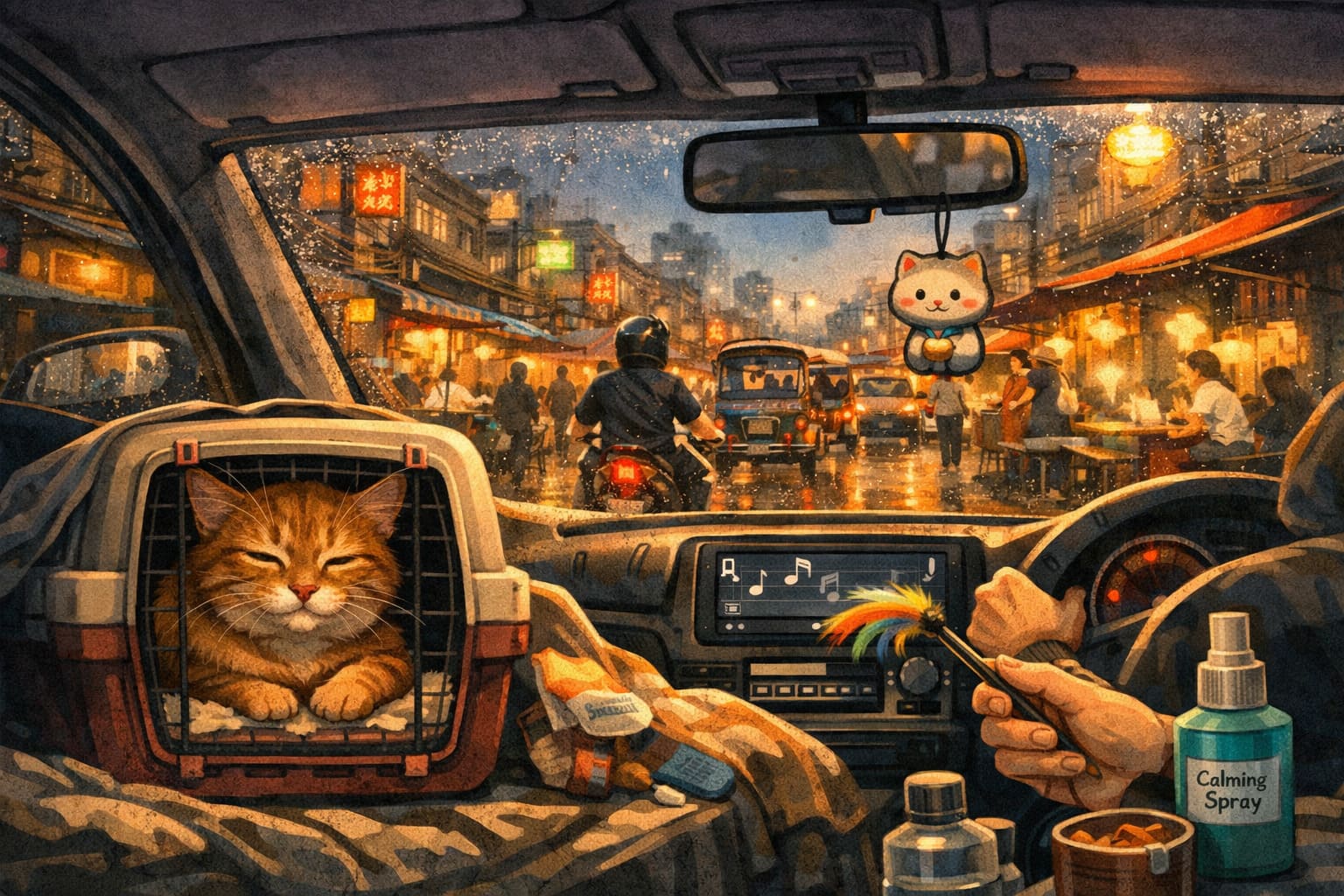
The sound started somewhere between the third-floor elevator and the lobby. It wasn’t a meow. It was a low-frequency, gut-wrenching wail that sounded like a violin being played by a very angry, very uncoordinated ghost. By the time I reached the car and buckled the carrier into the backseat, my cat, Mochi—a usually dignified ginger who spends 90% of his day judging my life choices from the top of the fridge—had turned into a puddle of liquid terror.
If you live in a dense Asian city like I do, you know the vibe. The humidity is already at 85%, the traffic in Jakarta (or Bangkok, or Manila, or Singapore—take your pick) is a gridlocked nightmare, and now you have a five-kilogram feline screaming like he’s being kidnapped by aliens. Every motorcycle that zooms past with a modified exhaust sends him into a fresh spiral of panic.
Why do they do it? Why can we train them to use a litter box and fetch hair ties, but the moment the engine purrs, they act like we’re driving them straight into the heart of a volcano? It’s a question that’s kept me up at night, usually after a particularly traumatic trip to the vet where I ended up more stressed than the cat.
The Sensory Assault (Or: Why the Car is a Horror Movie)
We have to look at this through their eyes—or rather, their whiskers. To a cat, a car isn’t a vehicle; it’s a vibrating, loud, smelly, unpredictable box of chaos.
Think about it. Most of our cats live in high-rise apartments or compact terrace houses. Their world is stationary. It’s a carefully curated kingdom that smells like laundry detergent, jasmine rice, and maybe a hint of that expensive candle you bought but never actually light. It’s predictable. Then, suddenly, we shove them into a plastic crate. The floor starts vibrating—a sensation they never experience at home unless there’s an earthquake or a particularly heavy-handed neighbor is doing renovations.
The smells change instantly from “home” to “petrol fumes, old air freshener, and exhaust.” In an Asian context, this sensory shift is dialed up to eleven. Our streets are noisy. There’s the constant beep-beep of delivery riders weaving through traffic, the roar of ancient buses, and the sudden lurches as we navigate narrow lanes or avoid a stray dog.
For a creature that relies on a hyper-sensitive sense of balance (that famous vestibular system) and a fierce territorial instinct, the car is an existential threat. They don’t know we’re just going to the vet for a routine check-up; for all they know, we’ve sold the apartment and are heading into the unknown wilderness of the suburbs.
And then there’s the motion sickness. Did you know cats get car-sick just like us? But unlike us, they can’t ask for a plastic bag or tell you to pull over. They just drool, pant, and let out those soul-piercing yowls. Honestly, I’ve felt like a monster more times than I can count, staring at the rearview mirror and seeing those dilated pupils. It makes you wonder: is the check-up even worth the psychological toll? (It is, obviously, but in the moment, you’ll doubt everything).
The Cultural Layer: The “Vet” Association
Let’s be real for a second. Why is the cat usually in the car?
In our culture, we don’t really do the “dog in the back of a pickup truck” thing with cats. Unless you’re one of those rare, social-media-famous “adventure cat” owners who takes their pet on hikes in the Cameron Highlands or to pet-friendly cafes in Mont Kiara (I envy your patience, truly), the car usually leads to one of two places: the vet or the boarding facility.
In Mochi’s mind, the sequence is a fixed, terrifying loop:
- The Scary Box comes out of the storeroom (usually smelling like dust and previous fear).
- The Loud Vibrating Machine happens.
- A stranger in a white coat pokes me with a needle or measures my temperature in a very… invasive way.
It’s a classic Pavlovian nightmare. We’ve essentially conditioned them to associate the car with a betrayal of trust. It’s like if your best friend told you were going for bubble tea but ended up taking you to a root canal appointment. Every. Single. Time. You’d start screaming in the parking lot, too, wouldn’t you? I know I would.
Changing the Narrative: It Starts with the “Box”
I used to keep the carrier hidden in the storeroom, tucked behind the vacuum cleaner and the boxes of old Mooncake tins. This was my first major mistake. Bringing the carrier out was like ringing a battle bell. The moment Mochi heard the plastic rattle, he’d vanish into the dark abyss under the bed, and I’d spend twenty minutes sweating and swearing as I tried to lure him out with treats.
I had to change the vibe. I brought the carrier into the living room and just… left it there. For weeks. My mom thought I was getting lazy with the chores, but it was a calculated move. I put a worn-out t-shirt of mine inside—something that smells like “safe human”—and threw in a few pieces of freeze-dried chicken.
At first, he glared at it from across the room, probably suspecting a trap. But curiosity is a powerful drug for a cat. Eventually, I’d find him napping in it. The “Scary Box” became the “Napping Box.” This is the foundation. If they aren’t terrified of the container, you’ve already won half the battle. If your cat sees the carrier as a safe haven rather than a prison cell, the journey is already 50% more peaceful.
The “Drive to Nowhere” Strategy (The Neighborhood Loop)
One weekend, I decided to do something that probably made my neighbors think I’d finally lost it. I put Mochi in the car, turned on the AC (full blast, because we’re in the tropics and the car felt like a sauna), sat in the driver’s seat, and… did nothing. We just sat there for fifteen minutes. I scrolled through my phone; he sniffed the upholstery and eventually settled down.
Then we went back inside. No needles. No strangers. Just cold air and silence.
The next day, we drove to the end of the block and back. I gave him a Churu—the holy grail of cat treats in this part of the world—the moment we got home. If you haven’t tried Churu, it’s basically feline crack. It bridges the gap between “I hate you” and “I might tolerate this for the meat-tube.”
We gradually increased the distance. Around the neighborhood. Past the local wet market where the smell of fish briefly caught his interest. Through the drive-thru (the staff at the window were very confused by the grumpy ginger face staring at them from the backseat). The goal is to break that “Car = Pain” association. You want them to think, Maybe we’re going to the vet, but maybe I’m just getting a snack and a scenic tour of the block. It takes time. It’s not a one-and-done thing. You have to be consistent. It’s like training for a marathon, but the marathon involves a screaming animal and the smell of fear.
Temperature Matters (More Than You Realize)
We live in a part of the world where “room temperature” is essentially a slow braise. A car parked in the sun for ten minutes becomes an oven. If you’ve ever wondered why your cat is panting and frantic, it’s likely because they’re genuinely overheating. Cats don’t sweat like we do; they pant to cool down, and by the time they’re panting, they’re already in distress.
Their fur is an insulator, but it has limits. I’ve learned to pre-cool the car. I’ll go down to the parking lot five or ten minutes early, crank the AC to its lowest setting, and wait until the interior feels like a shopping mall before bringing the cat down.
Also, consider the light. Our sun is aggressive. A cat in a carrier near a window is getting hit with direct UV rays. I started draping a thin, breathable sarong over half of the carrier. It creates a dark, “den-like” environment while still letting the cool air circulate. It’s about creating a little sanctuary amidst the chaos of the city. Plus, it stops them from seeing the dizzying blur of motorcycles zooming past, which helps with the motion sickness.
The Power of Pheromones and Weird Flute Music
I used to listen to loud podcasts or the radio while driving to drown out the meowing. Bad move. It just added to the noise pollution. Now? It’s “Cat Relaxing Music” on Spotify. Yes, it’s a real thing. It’s mostly low-frequency ambient sounds, soft piano, and recorded bird chirps.
Do I feel ridiculous driving through Saturday afternoon traffic while listening to Zen Flute Melodies for Anxious Felines? Absolutely. I’m pretty sure the guy in the Hilux next to me thinks I’ve joined a cult. But does it work? Surprisingly, yes. Mochi’s yowls went from “I am dying” to “I am mildly annoyed,” which is a huge upgrade.
There are also pheromone sprays like Feliway. You spray it on a towel inside the carrier about 15 minutes before you leave. It’s meant to mimic the “happy markers” cats leave when they rub their faces on furniture. It doesn’t work for every cat—Mochi seems 50/50 on it, depending on his mood—but for some, it’s like a glass of wine after a long day. It just takes the edge off the panic.
The “Aunty” Factor: Dealing with the Neighbors
In our neighborhoods, people are nosy (let’s be honest). When I’m carrying a screaming cat through the lobby, I always run into “Aunty Tan” or “Encik Yusof,” who want to know why the cat is crying. “Is he sick? Did you feed him?”
It adds a layer of social pressure. You feel like a bad “pawrent.” But here’s the thing: ignore the peanut gallery. Most people don’t realize how sensitive cats are. I’ve learned to just smile, nod, and keep moving. Your priority is the cat’s cortisol levels, not the neighbor’s curiosity.
I once had a neighbor suggest I should just “let him roam free in the car so he feels less trapped.” Please, for the love of all that is holy, do not do this. A free-roaming cat in a car is a projectile in an accident and a distraction that can cause one. Mochi once managed to squeeze out of a loose latch and ended up under the brake pedal. It was the scariest three seconds of my life. Keep them in the carrier. Safety over “freedom” every single time.
When All Else Fails: The Medical Route
Sometimes, despite your best efforts, the trauma is too deep. Some cats have such severe motion sickness or anxiety that no amount of Churu or flute music will help. They might vomit, urinate, or even collapse from stress.
I talked to my vet about this during a particularly bad stretch. There are safe, mild sedatives or anti-nausea medications (like Gabapentin or Maropitant) that can make a long move or a necessary trip much more humane.
There’s no shame in it. If your cat is literally harming themselves—pawing at the gate until their claws bleed or hyperventilating to the point of blue gums—medication isn’t “cheating.” It’s a mercy. It allows their brain to bypass the panic and just… sleep through the ordeal. We use it for long-distance moves or those inevitable “big” vet visits.
The Philosophy of the Passenger Feline
At the end of the day, I’ve realized that Mochi might never love the car. He’s never going to be one of those cool cats you see on Instagram wearing tiny goggles on the back of a Vespa. And that’s okay.
Living with a cat in an urban Asian environment is a series of compromises. We take them from the wild and put them in 800-square-foot concrete boxes with floor-to-ceiling windows. We ask them to tolerate the sound of construction next door, the smell of our sambal frying, and the indignity of the occasional bath. The least we can do is try to make the necessary car ride less of a descent into hell.
Changing their minds isn’t about a “hack” or a quick fix. It’s about empathy. It’s about recognizing that for fifteen minutes, their entire world is literally shaking, and they have no idea why. They don’t understand “preventative medicine” or “vaccination schedules.” They only understand that the person they love has put them in a box and taken them to a place that smells like dogs and medicine.
When we finally got back from our last vet trip—the one where I actually used these tips—Mochi didn’t hide under the sofa for six hours. He stepped out of the carrier, stretched, gave his tail a flick, and looked at me as if to say, “That was unnecessary, but I’ll accept the extra treats now.”
We aren’t just moving them from Point A to Point B. We’re asking for their trust. And in the world of a cat, trust is the most expensive thing you can own. It’s worth the extra ten minutes of pre-cooling the car. It’s worth the weird flute music. It’s worth being the “crazy cat person” in the parking lot.
Because when the engine finally stops and the familiar silence of the apartment returns, that little head-butt against your ankle makes all the yowling worth it.
Honestly, I think I need a Churu after that drive, too. Or maybe just a very cold iced teh tarik.
Quick Survival Guide for Your Next Trip:
- The Hunger Strike: Don’t feed them a big meal right before the car ride. A full stomach + a bumpy road = a mess you’ll be cleaning out of the upholstery for weeks.
- The Secure Buckle: Use the seatbelt through the carrier handle. A sliding box is a terrifying box. If the carrier shifts during a turn, the cat feels like the world is ending.
- Stay Calm: If you’re stressed and swearing at the traffic, they’ll pick up on that energy. Cats are emotional sponges. Channel your inner Zen master.
- Cover the View: A light towel or sarong over the carrier helps reduce visual over-stimulation. If they can’t see the motorcycles, the motorcycles can’t hurt them.